- FPSO hull configuration development
- Structural model coordination
- Accommodation design integration
- Project engineering management
- Technical documentation and class compliance
- Marine engineering support
- Offshore operational design review
- Structural optimization
- Safety and compliance evaluation
- Offshore systems integration
- Shipbuilding coordination
- Hull construction engineering
- Equipment integration studies
- Manufacturing capability evaluation
- Procurement and supply chain support
- Enhanced hydrodynamic performance
- Structural reinforcement for offshore loading conditions
- Long-term fatigue resistance
- Efficient storage capacity optimization
- Improved station-keeping compatibility
- Global structural analysis
- Finite element modeling
- Fatigue assessment studies
- Load and stress evaluation
- Structural integrity verification
- Harsh environment operational assessment
- Accommodation layout planning
- Safety zoning and escape route analysis
- HVAC and ventilation integration
- Offshore living standard compliance
- Noise and vibration reduction studies
- Crew welfare and operational support facilities
- Main power generation units
- Emergency power systems
- Energy distribution networks
- Fuel efficiency optimization
- Operational redundancy planning
- Emissions management considerations
- Mooring support systems
- Marine utility systems
- Cargo handling equipment
- Ballast control systems
- Navigation and communication systems
- Offshore safety equipment
- Integrated vessel control systems
- Process automation platforms
- Remote monitoring capabilities
- Predictive maintenance systems
- Safety automation integration
- Data-driven operational support tools
Key Project Highlights
| Project Feature | Description |
|---|---|
| Project Name | Project ODYSSEY |
| Vessel Type | FPSO Newbuilding |
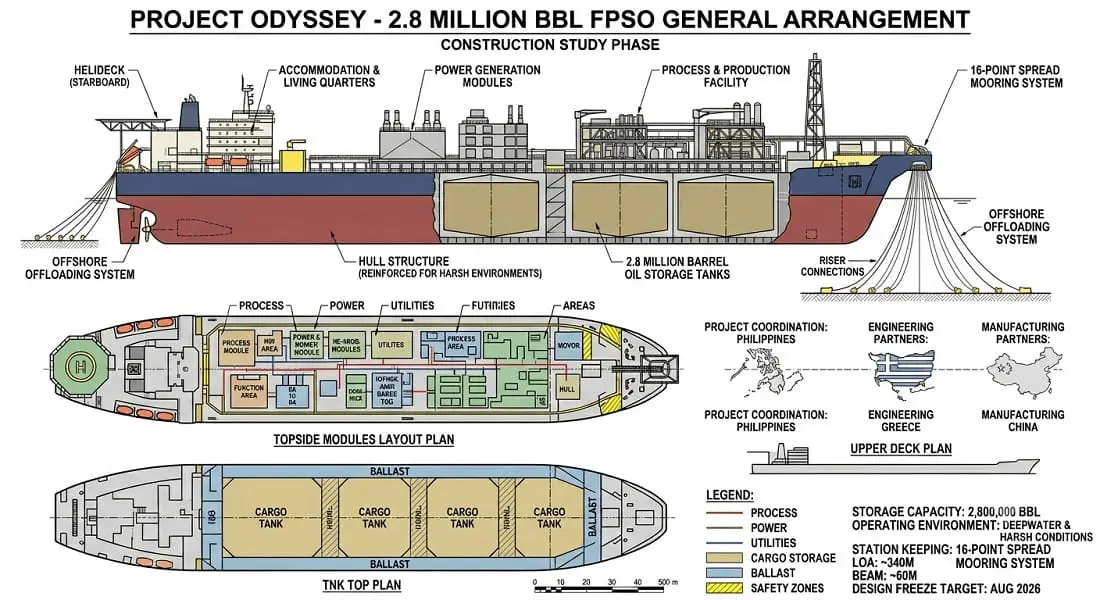
| Storage Capacity | 2,800,000 Barrels |
| Operating Environment | Deepwater & Harsh Environment |
| Engineering Collaboration | Philippines, Greece, China |
| Current Phase | Construction Study & Engineering Development |
| Focus Areas | Hull Design, Structural Engineering, Machinery Integration, Automation, Offshore Sustainability |
| Quick Access |
|---|
| FPSO Case Studies |
| FPSO – PAMS Blog |
| Download FPSO Master Scope |
- Increased offshore production capability
- Enhanced operational reliability
- Improved offshore safety systems
- Advanced automation integration
- Long-term sustainability support
- High-capacity storage performance
FPSO Technical & Operational FAQ
What are the main advantages of an FPSO?
FPSOs eliminate the need for costly subsea pipelines by storing processed oil directly on board until it is offloaded to shuttle tankers. They offer excellent mobility and commercial flexibility for remote deepwater fields.
How do FPSO mooring systems function?
FPSOs use spread mooring or turret mooring systems. Turret mooring allows the vessel to "weathervane" (rotate 360 degrees freely) to face oncoming wind, waves, and currents, minimizing environmental load stress.
What is included in the topsides process?
The topsides production facility receives fluids from subsea wells and processes them to separate oil, natural gas, and produced water. Cleaned oil is routed down to storage tanks, while gas is reinjected or utilized.
How is safety managed on an FPSO?
Safety relies on strict spatial segregation between the high-risk topsides processing area and the living quarters. Automated shutdown systems, gas detection arrays, and fire suppression systems protect the crew and asset.